
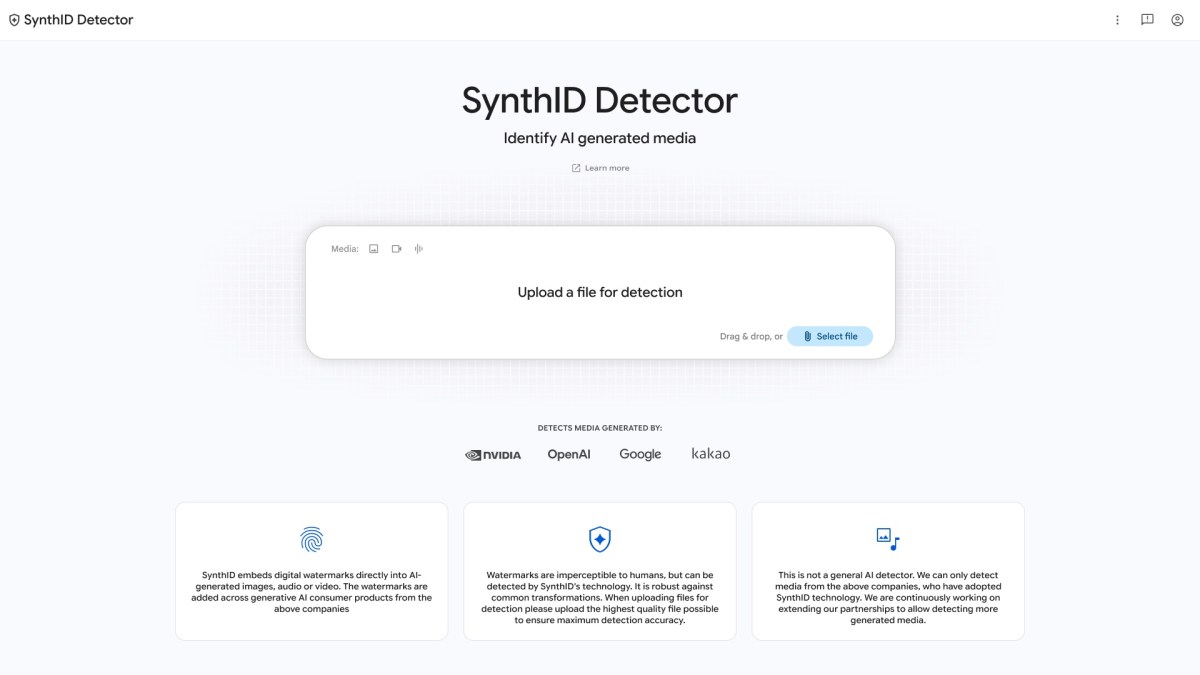
Google has launched SynthID, a new tool designed to identify AI-generated multimedia content, marking a significant step in the fight against misinformation and digital manipulation.
What happened
On October 7, 2026, Google introduced SynthID, a web platform that allows anyone to verify the origin of images, videos, and audio clips, determining if they were created with AI. This technology, developed by Google DeepMind, embeds an invisible digital watermark directly into AI-generated content, making it detectable even after modifications like resizing or compression Google's new SynthID website can identify AI-generated media. This launch occurs during a period of intense activity in the AI sector, as evidenced by TechCrunch Disrupt 2026 in San Francisco, an event that saw the participation of over 10,000 people and key figures like Alexander Embiricos from OpenAI, discussing the latest innovations and emerging challenges OpenAI’s Alexander Embiricos is coming to TechCrunch Disrupt 2026 — days after the launch of Dots. Concurrently, Google Labs is experimenting with Playground, an AI-powered platform for creating browser-based games using simple text prompts, highlighting AI's dual nature: a tool for creation and, at the same time, a source of new authenticity challenges Google experiments with an AI-powered gaming platform.
Why it matters
The introduction of SynthID is crucial in an era where generative AI makes it increasingly difficult to distinguish between reality and fiction. The proliferation of deepfakes and synthetic content has the potential to undermine trust in information, influence public opinion, and even destabilize democratic processes. The ability to identify the AI origin of content is not just a technical matter, but a fundamental pillar for safeguarding informational integrity. For journalists, researchers, and the general public, tools like SynthID offer an essential verification mechanism, helping to restore a level of trust in an increasingly saturated digital ecosystem. Without such tools, the risk of large-scale misinformation and perceived reality manipulation would increase exponentially, with serious repercussions on society and people's ability to make informed decisions.
The HDAI perspective
The vision of Human Driven AI (HDAI) places humans at the center of AI development and application. Google's initiative with SynthID aligns perfectly with this philosophy, recognizing that technological innovation must be accompanied by tools that mitigate its risks and ensure responsible use. It is not enough to create powerful technologies; it is imperative to also develop the control and verification mechanisms that protect society. Transparency about the origin of AI content is a fundamental step towards ethical AI and effective AI governance. This proactive approach is essential for building a future where AI is an ally of humanity, not a threat to its perception of reality. Topics such as digital authenticity and responsibility in AI will be central to discussions at the HDAI Summit 2026, where experts and leaders will address how to balance innovation and security.
What to watch
The future will likely see an escalation in the "arms race" between the creation of increasingly sophisticated AI content and the tools for its identification. It will be crucial to observe how regulations, such as the EU AI Act, will adapt to integrate these new verification capabilities. The adoption of industry standards for marking AI content and collaboration among tech companies, governments, and civil society will be vital to ensure that technology serves to strengthen, rather than erode, trust in the digital world.